

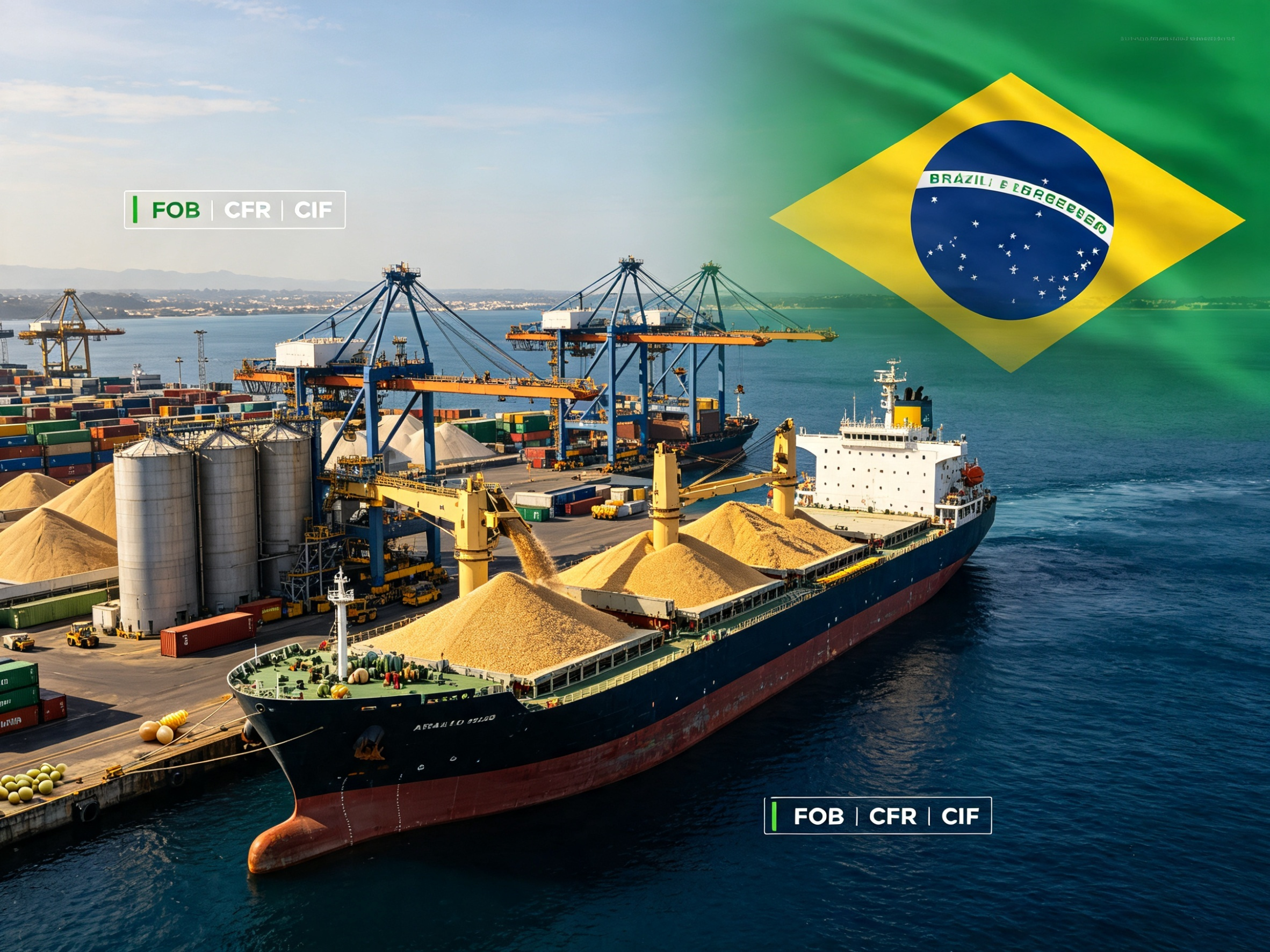
FOB vs CIF vs CFR for Brazilian Imports: Which Incoterm Should You Choose?

Choosing the wrong Incoterm is the fastest way to turn a cheap Brazilian price into an expensive landed cost. Under FOB, your Brazilian supplier loads the goods on board at a named Brazilian port (Santos or Paranaguá, for example) and you pay ocean freight and insurance. Under CIF, the supplier pays freight and minimum cargo insurance to your destination port. Under CFR, the supplier pays freight only, and you insure the cargo yourself. In all three, risk transfers when goods are on board at the Brazilian port, not when they arrive at your warehouse. This guide shows which term fits your operation, and which Brazilian cargo types change the answer.
Most generic “FOB vs CIF” articles stop at dictionary definitions from the International Chamber of Commerce (ICC). They rarely explain how those rules play out on a soybean bulk vessel from Paranaguá, a reefer container of frozen chicken from Santos, or a flexitank of soybean oil, or what Brazilian exporters actually need from you before they can issue a proforma. This guide is written for procurement managers, importers and distributors sourcing agricultural commodities from Brazil, with practical detail you will not get from a one-page logistics glossary.
What Are Incoterms?
Incoterms (International Commercial Terms) are standardized three-letter trade rules published by the International Chamber of Commerce (ICC). They define who arranges carriage and insurance, who pays which costs, and where risk transfers from seller to buyer. They do not by themselves define title transfer, payment method, or quality specifications. Those stay in your sales contract.
The current ruleset widely used in contracts is Incoterms® 2020 (still the active ICC set in 2026; always confirm the edition named in your contract). For Brazilian seaborne agri-exports, the three terms you will see most often on quotes from exporters like SAI AGRO BRAZIL LTDA are FOB, CFR and CIF.
Brazilian grain and sugar trades often move on bulk vessels (not only containers). Incoterms still apply, but “on board” and laytime/demurrage language in the charter party sit alongside the Incoterm. A clean FOB container quote is not the same commercial instrument as FOB bulk with NOR (Notice of Readiness) and demurrage clocks. Always ask whether the offer is containerized or bulk vessel before you compare two “FOB Santos” prices.
FOB (Free On Board): What It Means for Brazilian Imports
FOB [named Brazilian port of shipment] means the seller delivers when the goods are on board the vessel nominated by the buyer (or the buyer’s freight forwarder) at that port. The seller typically handles export clearance in Brazil, inland haulage to the terminal, and loading costs up to the point of delivery. The buyer pays ocean freight, insurance, destination terminal handling, import clearance and inland delivery.
What the Brazilian seller usually covers under FOB
- Export packaging and stuffing (bags, cartons, flexitank installation, bulk loading as agreed)
- Export customs formalities and SISCOMEX-related export registration handled on the Brazilian side
- Delivery to the terminal / vessel and loading “on board” at the named port (e.g. FOB Santos, FOB Paranaguá)
- Commercial invoice, packing list, and cooperation on documents needed for the B/L
What you (the buyer) usually cover under FOB
- Ocean freight booking and freight payment
- Marine cargo insurance (you choose insurer and coverage level)
- Destination charges, customs clearance, duties/VAT, and inland trucking
- Carrier nomination timing. Late vessel nomination can create storage (demurrage/detention) exposure at Brazilian terminals
Brazil-specific example (container, illustrative): You buy 1×40′ HQ of bagged ICUMSA 45 sugar, FOB Santos. SAI AGRO prepares bags, docs and loads the container onto the vessel you (or your forwarder) booked. From the moment the goods are on board, risk is yours. If the vessel is delayed after loading, cargo risk and insurance claims follow your policy, not the seller’s CIF cover.
On Brazilian bulk grain FOB, buyers often appoint a surveyor at load port (weight/quality). That surveyor’s certificate becomes the commercial reference for claims. Put surveyor appointment deadlines in the proforma or sales contract, not only in email.
CIF (Cost, Insurance & Freight): What It Means for Brazilian Imports
CIF [named destination port] means the seller pays the cost of goods, main carriage freight to that port, and minimum cargo insurance for the buyer’s benefit. Delivery (and risk transfer under the Incoterm) still occurs when goods are on board at the origin port, not when the ship berths at your port. That single fact confuses many first-time buyers who assume “CIF means the seller carries all risk until arrival.”
What CIF gives you
- One commercial quote that already includes ocean freight and baseline insurance
- Simpler budgeting when you do not yet have a preferred carrier or open cargo policy
- Seller-managed booking (useful when Brazilian export peaks congest Santos/Paranaguá and the exporter has regular liftings)
What CIF does not automatically give you
- All-risk, full-value insurance. ICC minimum cover under CIF is limited. Sensitive cargo (reefer meat, high-value oils) often needs buyer top-up or a different insurance structure.
- Control of carrier and routing. The seller chooses the vessel/line that meets the contract. That can be cheaper or slower than your preferred schedule.
- Inland delivery past the destination port. CIF ends at the named port, not your factory gate (that would be a different door-to-door arrangement outside classic sea Incoterms).
Under CIF, insist the seller provides the insurance certificate (or policy) with the document set required by your bank under L/C. Delayed insurance docs are a common discrepancy on Brazilian agri L/Cs. Put “insurance certificate dated not later than B/L date” in the L/C wording if your bank allows.
CFR (Cost and Freight): The Middle Ground
CFR [named destination port] is CIF without seller-arranged insurance. The seller pays freight to your port; you buy cargo insurance. Risk still transfers on board at the Brazilian load port.
CFR is common when:
- You already hold an open marine cargo policy with better rates or broader cover than CIF minimums
- Your insurer requires you to declare shipments yourself for claims efficiency
- You want seller-managed freight but buyer-controlled insurance (typical for experienced traders and processors)
When CFR beats CIF on Brazilian oils: Flexitank vegetable oil shipments sometimes face residual product and contamination claims. Buyers with specialist liquid-cargo policies often prefer CFR + own insurance over CIF minimums that were designed for general merchandise. Ask your underwriter which Incoterm they prefer before you lock the sales contract.
FOB vs CIF vs CFR: Side-by-Side Comparison
| Point | FOB (Brazil port) | CFR (destination port) | CIF (destination port) |
|---|---|---|---|
| Who books ocean vessel? | Buyer / buyer's forwarder | Seller | Seller |
| Who pays ocean freight? | Buyer | Seller | Seller |
| Who arranges cargo insurance? | Buyer | Buyer | Seller (minimum cover) |
| Risk transfers | On board at Brazilian port | On board at Brazilian port | On board at Brazilian port |
| Export clearance (Brazil) | Seller | Seller | Seller |
| Import clearance (your country) | Buyer | Buyer | Buyer |
| Best when | You control logistics & insurance | You want seller freight + own policy | You want simple landed freight+insurance |
| Typical Brazilian agri use | Experienced traders; bulk FOB; container FOB Santos/Paranaguá | Processors with open cover | First imports; distant destinations; smaller buyers |
Illustrative cost stack (not a live quote): Same product, same volume, same week. Structure only.
Comparing only the headline unit price without unbundling freight and insurance is how buyers "save" 2% on paper and lose 5% in uncontrolled destination charges. Always request a cost breakdown or parallel FOB and CIF offers for the same shipment.
Which Incoterm Should Importers from Brazil Choose?
- First shipment, limited logistics team, need one number for finance approval: Start with CIF, then negotiate insurance top-up if cargo is reefer or high value.
- You have a forwarder and open cargo policy: Prefer FOB (control) or CFR (seller freight + your insurance).
- Bulk vessel soybeans/corn/sugar: Often FOB load port with detailed laytime, demurrage and survey clauses. Treat the charter party as part of the commercial package.
- Liquid oils in flexitank: FOB or CFR frequently; verify flexitank brand, heater pads (if any), and residual liability before choosing CIF minimum insurance alone.
- Frozen meat in reefer: CIF can simplify booking peak reefer space; still demand temperature records and adequate insurance wording.
Decision shortcut: If you cannot name your preferred carrier and insurer today, you are not ready for pure FOB operationally, even if FOB looks cheaper. Capability first, unit price second.
How SAI AGRO BRAZIL Handles Incoterms
SAI AGRO BRAZIL LTDA, based in Cotegipe, Bahia, supports FOB, CFR and CIF on agricultural commodities for buyers across Africa, Asia, Europe and the Middle East, subject to product, volume, season and vessel/container availability.
When you request a quote, include:
- Product and grade (e.g. GMO soybeans, ICUMSA 45, frozen chicken leg quarters)
- Volume (MT or containers)
- Destination country and preferred port
- Preferred Incoterm (or “advise us”)
- Packaging preference (bulk, bags, cartons, flexitank, reefer)
Related guides: How to Import from Brazil · Container Shipping from Brazil · How to Verify a Brazilian Exporter · Commodities
Ready to price FOB, CFR or CIF?
Share volume, destination and preferred term with our commercial desk.
Frequently Asked Questions
What is the difference between FOB and CIF when importing from Brazil?
FOB: seller delivers on board at the Brazilian port; buyer pays freight and insurance. CIF: seller pays freight and minimum insurance to the named destination port. Risk under both typically transfers on board at origin.
Is CFR the same as CIF?
No. CFR includes seller-paid freight but not seller-paid insurance. You insure the cargo yourself under CFR.
Does FOB mean the seller pays nothing after the factory?
No. Under FOB the seller still gets goods to the named port and on board, including export formalities. "Ex Works" is the term where the buyer takes goods at the seller's premises.
Which Incoterm is better for first-time importers from Brazil?
Many start with CIF for simpler budgeting, then move to FOB or CFR once freight and insurance partners are in place.
Can one contract mix FOB and CIF?
Yes. Different shipments or products can use different terms. Never leave the Incoterm ambiguous on the proforma invoice.
Does SAI AGRO BRAZIL offer FOB, CFR and CIF?
Yes, subject to product, volume and destination. Use the trade inquiries form.
Disclaimer: This article is educational, not legal advice. Incoterms® is a trademark of the ICC. Always name the Incoterm edition in your contract and confirm terms with your freight forwarder, insurer and counsel. Illustrative costs are structural examples, not live freights.