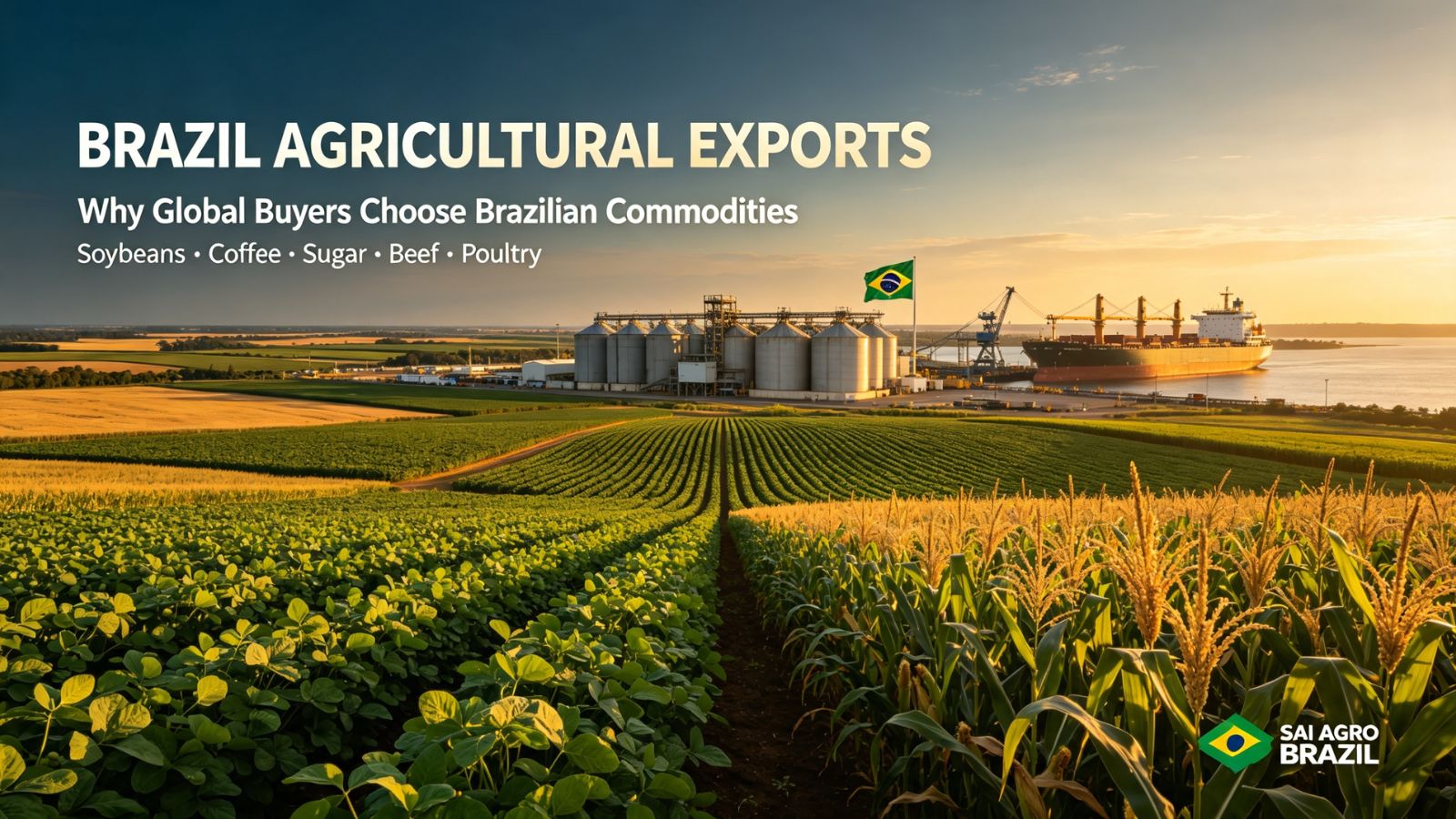
Brazil Agricultural Exports: Why Global Buyers Choose Brazilian Commodities

This overview is written for procurement managers and importers evaluating Brazil as a supply origin. For the practical side, see How to Import from Brazil and Shipping from Brazil.
Brazil's Global Export Rankings: Where It Leads
Brazilian agribusiness regularly holds the #1 global position in several commodities. Figures below are indicative ranges compiled from USDA, CONAB and FAO data; treat them as market context, not a contract reference.
Largest Soybean Exporter
~55%+
of global soybean
trade
Largest Coffee Exporter
~35%+
of global coffee
trade
Largest Sugar Exporter
~40%+
of global sugar
trade
Largest Beef Exporter
~20%+
of global beef trade
Largest Poultry Exporter
~35%+
of global chicken
trade
Largest Orange Juice
Exporter
~70%+
of global OJ trade
A #1 exporter operates at a scale that creates liquid supply, competitive pricing and deep logistics ecosystems. When Brazil leads a commodity, buyers benefit from frequent vessel strings, large terminal throughput and experienced export houses, advantages that show up in freight options and contract flexibility, not just headline production numbers.
The Brazilian Advantage: 5 Reasons Global Buyers Choose Brazil
1. Two Growing Seasons (Safra & Safrinha)
Brazil’s tropical climate allows a summer crop (safra) and a second winter crop (safrinha) in the same calendar year, most notably in soybeans followed by corn. This dual-harvest rhythm means supply flows to ports in multiple windows, smoothing availability and reducing single-harvest dependency. For an importer, that translates into more contract timing options than a single-season origin can offer.
2. Competitive Production Costs
Combinations of abundant land, favorable climate, and efficient farming at scale keep Brazilian cost-per-ton competitive against US and European production. Lower production cost is one reason Brazilian offers can be structurally attractive, and why buyers compare origin cost curves before negotiating.
3. World-Class Port Infrastructure
Santos, Paranaguá and Rio Grande anchor an export system with modern grain terminals, reefer facilities and container capacity, with significant private terminal investment in recent years. See our shipping guide for transit detail.
4. Strong Regulatory Framework
Exports move under MAPA (Ministry of Agriculture), with SIF inspection for animal products, SISCOMEX customs control, and farm-to-port traceability in several sectors. These systems are recognized by import authorities worldwide and are a major reason Brazilian shipments clear destination inspection reliably.
5. Trade Agreements & Market Access
Mercosur agreements, expanded market access with China, the Middle East, Africa and the EU, and active sanitary-negotiation agendas keep Brazilian products competitive on tariffs and certifications. New market openings (e.g., poultry, beef, corn) periodically expand destination options for buyers.
Brazil's Key Agricultural Regions
| Region | Signature products |
|---|---|
| Cerrado (Central-West) | Soybeans, corn, cotton, cattle |
| MATOPIBA (NE frontier: Maranhão, Tocantins, Piauí, Bahia) | Soybeans, cotton, corn, pulses |
| South (RS, SC, PR) | Wheat, rice, soybeans, pork, poultry |
| Southeast (SP, MG, ES) | Coffee, sugar, citrus, beef |
| Northeast (BA, PE, CE) | Cocoa, tropical fruits, sugar, dairy |
The MATOPIBA region has become a soy and cotton frontier with double-cropping and rapidly improving logistics. Buyers sourcing from Bahia-linked exporters get access to this growing belt as well as Northeast cocoa and fruit programs, an origin mix that broadens supply resilience versus single-state sourcing.
Quality & Sustainability: How Brazil Meets Global Standards
Brazilian agribusiness increasingly runs on traceability systems, deforestation-free certification programs, organic production lines and low-carbon agriculture initiatives. Exporters and cooperatives publish sustainability documentation because global buyers require it. It is now standard commercial practice, not a niche. When you request certifications from a Brazilian supplier, the infrastructure to provide them exists across the sector.
What to actually request: Beyond organic labels, ask for traceability documentation, GMP/FSSC or equivalent food-safety certificates, and the specific destination-market certification (e.g., EU deforestation regulation compliance or GCC halal certification). A serious exporter answers these without friction.
Why Importers Trust Brazilian Suppliers
Trust in Brazilian suppliers rests on scale, regulatory structure and long international-trade experience: large export volumes mean established banks, carriers and inspection networks; SISCOMEX- and MAPA-governed processes mean documentation is standardized; and decades of serving China, the EU, the Middle East and Africa mean exporters understand destination requirements. For the practical step-by-step, read How to Verify a Brazilian Exporter.
How Sai Agro Brazil Contributes to Brazil's Export Leadership
As a Brazilian exporter headquartered in Cotegipe, Bahia, SAI AGRO BRAZIL participates in this agricultural powerhouse. We source from Brazil’s best producing regions and deliver to buyers across Africa, the Middle East, Asia and Latin America. Our program covers grains, sugar, vegetable oils, meat and more. See our commodities, about us, and how we work pages. Our certifications include SIF-registered meat operations, phytosanitary-compliant grain and produce programs, and SISCOMEX-registered export operations with auditable documentation. We are part of Brazil’s export success story, and we put that record in writing for every buyer who asks.
Evaluating Brazil as a supply origin?
Request our product programs, certifications and export documentation.
Frequently Asked Questions
What is Brazil's #1 export?
Soybeans are consistently among Brazil's top exports by value; on the agricultural side, soybeans, corn, sugar and beef lead the export basket.
Is Brazilian agriculture sustainable?
Brazil operates traceability systems, deforestation-free certification programs and a national low-carbon agriculture plan (ABC Plan) supporting sustainable intensification.
How does Brazil compare to the US in agricultural exports?
Brazil leads in soybeans, coffee, sugar, beef and poultry; the US leads in corn, wheat and overall agricultural export value. The two compete head-to-head in soybeans each season.
What does Brazil export to China?
China is Brazil's largest agri trading partner, buying mainly soybeans, corn, beef, poultry and pulp.
Can Brazil supply year-round?
Yes. The safra/safrinha double-cropping system plus regional diversity keeps supply flowing across more of the calendar than single-season origins.
Rankings and shares are indicative ranges compiled from public USDA, CONAB, FAO and ICO reports; market data changes. Confirm current figures for commercial decisions.