

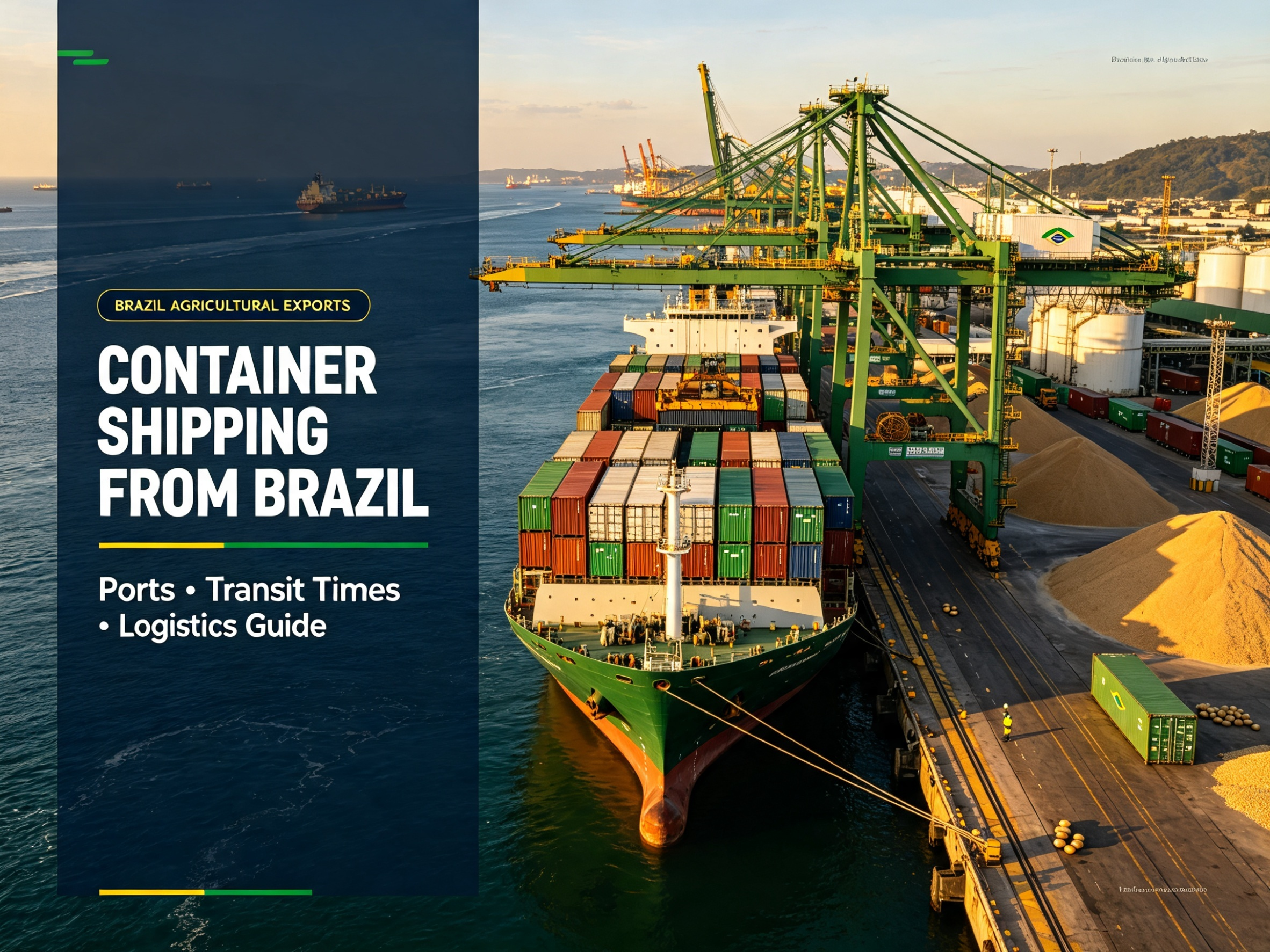
Container Shipping from Brazil: Ports, Transit Times & Shipping Guide

A container loaded in Santos can reach Lagos in roughly two weeks, Genoa in under three, and Shanghai in five. That spread is why shipping decisions, not just unit prices, decide whether a Brazilian order lands on time. Agricultural cargo from Brazil typically spends 10 to 35 days at sea depending on load port, carrier string and congestion, and it moves through four main gateways: Santos (SP), Paranaguá (PR), Rio Grande (RS) and Northeast ports such as Salvador (BA). Cargo ships in dry containers, reefers, flexitanks or ISO tanks, and on bulk vessels, and the right mode is a product decision, not a one-size default.
This guide is for importers planning FOB/CFR/CIF purchases with exporters such as SAI AGRO BRAZIL LTDA.
Related: FOB vs CIF vs CFR · How to Import from Brazil.
Brazil's Major Export Ports: What Ships from Where
Port of Santos (São Paulo)
Latin America’s largest port complex and the default multi-commodity gateway. Common for bagged sugar, coffee, containerized grains and seeds, vegetable oils in flexitank, and high volumes of reefer meat and poultry. Strength: carrier choice and frequency. Watch-out: peak-season terminal congestion and appointment discipline for truck gates.
Port of Paranaguá (Paraná)
A primary grain export powerhouse for soybeans, corn and related bulk/container programs linked to Paraná and Center-South production. Strength: grain terminal depth. Watch-out: weather and queue dynamics in export peaks after inland harvest pulses.
Port of Rio Grande (Rio Grande do Sul)
Southern gateway for rice, grains, some meats and regional production. Useful when origin logistics favor the South rather than forcing everything through Santos.
Port of Salvador & Northeast options (Bahia corridor)
Relevant for Bahia-linked cargoes: cocoa, tropical products, and structured programs from Northeast origins. SAI AGRO BRAZIL is based in Cotegipe, Bahia; load port on any offer should be read as a priced commercial choice, not an afterthought.
Studies of Brazilian grain export corridors (interior road/rail to port) show that inland leg + queue time can rival pure ocean days in total lead time variance. That is why professional buyers track "gate-in to vessel departure" as carefully as "sailing days to destination."
Buyer question that changes the quote: "Is this FOB price based on Santos gate-in or interior warehouse?" Interior FOB-equivalent structures exist in trade practice but must be contractually defined. Never assume two FOB numbers use the same delivery point.
Transit Times from Brazil to Major World Regions
Indicative ocean transit bands (port-to-port sailing windows commonly observed on mainline strings; not guarantees). Always reconfirm with the live schedule for your booking week. Last reviewed: July 2026.
| Destination region (example ports) | From Santos | From Paranaguá | From Salvador (indicative) |
|---|---|---|---|
| West Africa (e.g. Lagos, Tema) | 12-16 days | 14-18 days | 10-14 days |
| Southern Africa (e.g. Durban) | 14-20 days | 15-21 days | 13-19 days |
| East Africa (e.g. Mombasa, Dar) | 18-24 days | 20-26 days | 17-23 days |
| North Europe (e.g. Rotterdam, Hamburg) | 14-19 days | 16-21 days | 15-20 days |
| Mediterranean (e.g. Genoa, Valencia) | 12-17 days | 14-19 days | 13-18 days |
| Middle East (e.g. Jebel Ali, Jeddah) | 18-24 days | 20-26 days | 17-23 days |
| South Asia (e.g. Nhava Sheva, Chittagong) | 22-28 days | 24-30 days | 21-27 days |
| SE Asia (e.g. Singapore, Port Klang) | 25-32 days | 27-34 days | 24-31 days |
| East Asia (e.g. Shanghai, Busan) | 28-37 days | 30-39 days | 27-36 days |
| US East Coast (e.g. NY/NJ) | 12-17 days | 14-19 days | 13-18 days |
| US Gulf (e.g. Houston) | 14-20 days | 16-22 days | 14-20 days |
| River Plate (e.g. Buenos Aires) | 5-8 days | 4-7 days | 7-11 days |
How to use this table: Add 3-10 days for export terminal dwell in peak season, plus destination free time planning. Reefer connections and bulk vessel laycans follow different calendars than dry container loops.
Many Asia and some Africa services relay via hub ports. A 28-day "direct-looking" string can become 35+ with missed connections. Ask the forwarder: direct or hub? which hub? historical integrity %? The answer separates a planning estimate from a commitment.
Container Types & Options for Brazilian Exports
| Mode | Typical payload (order of magnitude) | Best for | Buyer notes |
|---|---|---|---|
| 20' dry | ~18-24 MT depending on commodity density | Dense bagged goods, trial lots | Watch payload vs road limits inland |
| 40' / 40'HQ dry | ~24-28 MT common for many bagged agri | Sugar, coffee, pulses, seeds | Cube helps light products; weight still caps dense cargo |
| 20'/40' reefer | ~20-26 MT frozen meat typical ranges | Beef, poultry, some seafood | Set-point, pre-trip, power reliability critical |
| Flexitank in 20' | ~21-24,000 L class installations | Soy/sunflower/corn oils | Single-use bladder; residual & heater rules matter |
| ISO tank | ~20-26,000 L class | Liquids needing multi-trip steel tanks | Higher positioning complexity; excellent for some syrups/oils |
| Bulk vessel | Thousands to tens of thousands MT | Soy, corn, VHP sugar | Laytime/demurrage discipline; surveyors at load/disport |
Food logistics research on frozen protein trade stresses that temperature abuse is usually a multi-point failure (stuffing, terminal power, vessel reefer towers, discharge), not only “the ocean leg.” Contract for data logger access and define claim evidence (reefer downloads) before sailing, not after arrival surprises.
Major Shipping Lines Serving Brazilian Export Routes
Main global carriers and alliances regularly serve Brazilian ports, including names such as MSC, Maersk, CMA CGM, COSCO, Hapag-Lloyd, ONE, Evergreen and others depending on string. Carrier choice should be driven by:
- Schedule integrity on your specific OD pair
- Reefer plug availability (for meat)
- Equipment availability inland (for dry and flexitank)
- Free time at destination
- Demurrage/detention tariffs
SAI AGRO coordinates shipment with market carriers based on product and destination; buyers on FOB often nominate via their forwarder.
How to Choose the Right Shipping Method for Your Product
- Frozen protein → reefer container; prioritize plug reliability and carrier reefer reputation.
- Bagged dry food staples → 20’/40′ dry; optimize bag specification for stow and moisture.
- Liquid oils → flexitank or ISO tank; confirm heater/residue rules.
- Very large grain/sugar parcels → bulk vessel economics usually win.
- Mixed SKU trials → container LCL is rarely ideal for bulk agri; plan FCL MOQs.
Then choose Incoterm: FOB vs CFR vs CIF.
Port Congestion & Seasonal Considerations
- Grain export peaks after major harvest pulses increase vessel queues and truck appointments.
- Safrinha corn flows can re-load export corridors mid-year, so plan capacity early.
- Sugar seasonality and mill crush calendars affect bagged availability and terminal pressure.
- Year-end holidays (Brazil and destination) cut gate hours and bank document processing.
- Rain events can slow inland trucking and outdoor terminal operations.
Planning buffer used by experienced buyers: Quote ETA to sales teams as ocean band + 7-14 days contingency during Brazilian agri peaks, especially for promotional retail windows. Under-buffering is a common cause of stockouts blamed on "the exporter" when the real issue was corridor congestion.
How SAI AGRO BRAZIL Manages Shipping Logistics
SAI AGRO BRAZIL LTDA supports containerized and structured bulk programs with documentation, packaging planning and shipment coordination under FOB, CFR and CIF as agreed. Share destination port, volume and cargo type so the commercial desk can propose a realistic load port and mode.
Planning a shipment from Brazil?
Send product, MT/containers, destination port and preferred Incoterm.
Frequently Asked Questions
What is the cheapest way to ship agri goods from Brazil?
For large homogeneous parcels, bulk vessel is often cheapest per MT. For smaller lots, optimize container utilization and avoid destination demurrage. "Cheap freight" is meaningless if free time is burned.
Do I need a freight forwarder?
On FOB, yes in most cases. On CIF, the seller books main carriage, but you still need destination delivery partners.
How do I track my container?
Use carrier tracking with container and B/L numbers; for reefers, request temperature monitoring access as contracted.
What is demurrage vs detention?
Demurrage generally relates to container use inside the terminal after free time; detention relates to container use outside. Definitions vary by carrier tariff. Read the tariff that applies to your booking.
Transit times are indicative planning bands, not contractual commitments. Schedules, routings and congestion change. Confirm with live carrier data before commercial deadlines.