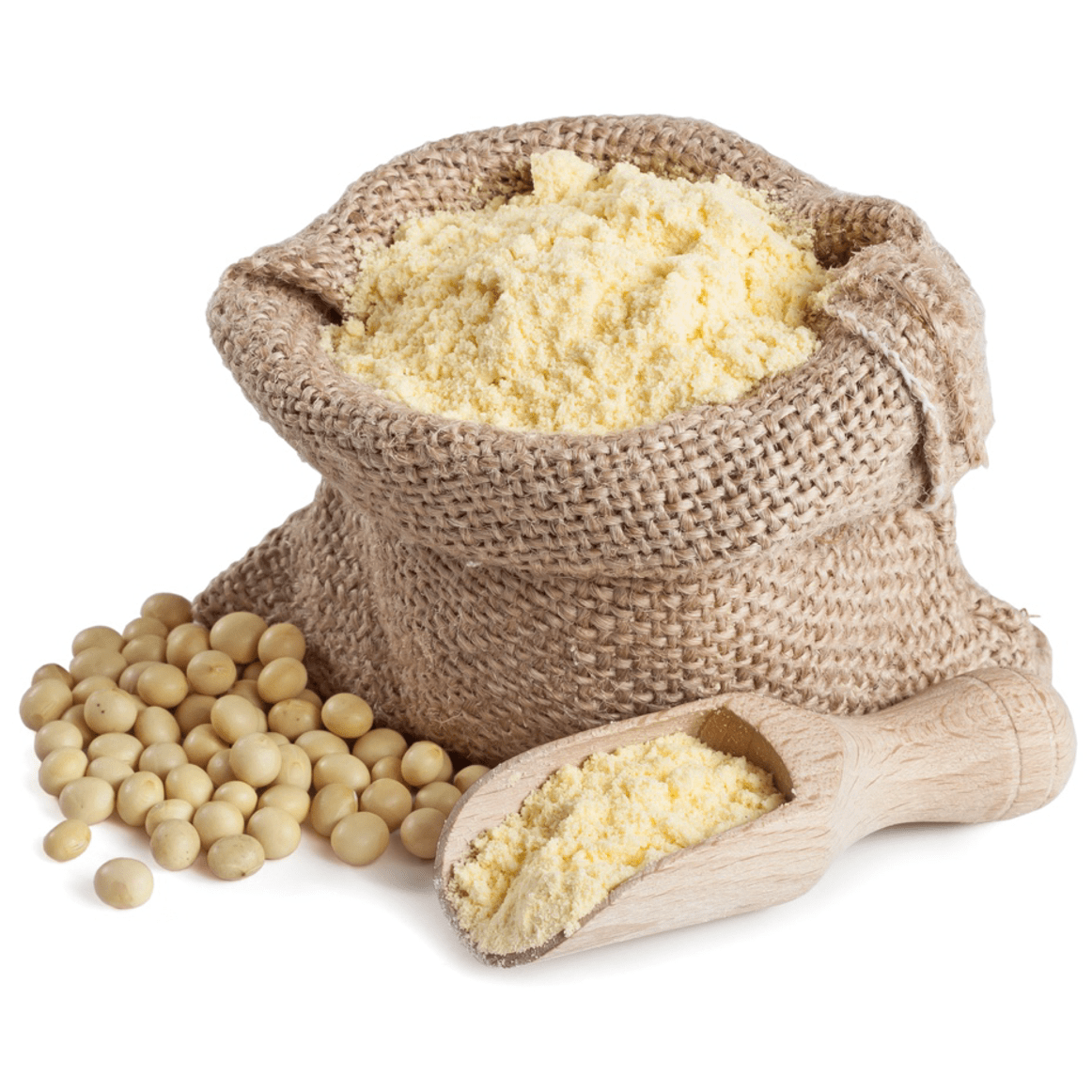
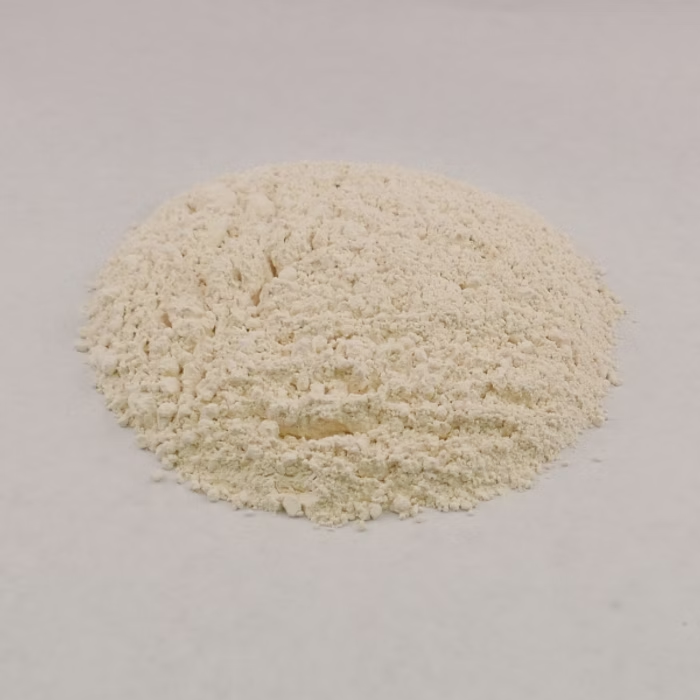
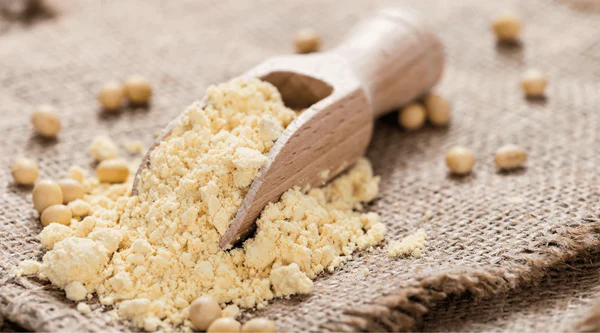
Soybean flour in PDI Grades 20, 70, and 90 for bakery, meat analogs, and extruded snacks. Protein 34-50% depending on grade. GMO and non-GMO options. Moisture 6% max, 95% through 75 micron. 25kg bags or bulk. FOB/CFR/CIF terms. 12-month shelf life. Brazil produces 8-10 million MT annually. PDI 90 ideal for meat analogs, PDI 70 for bakery, PDI 20 for feed. 10-20% lower cost than U.S. origin.
| Parameter | Specification |
|---|---|
| PDI Grades | 20, 70, 90 |
| Type | GMO / Non-GMO |
| Protein | 34-50% |
| Moisture | 6% max |
| Packaging | 25kg bags / Bulk |
| Shelf Life | 12 months |
| Terms | FOB / CFR / CIF |
| Origin | Brazil |
SAI AGRO BRAZIL is a Brazilian exporter of soybean flour in PDI Grades 20, 70, and 90, supplying bakery ingredient producers, meat analog manufacturers, extruded snack companies, and nutritional product blenders worldwide. We offer both GMO and Non-GMO soybean flour with protein content ranging from 34% to 50%, depending on grade and fat content (full-fat or defatted). Shipment terms include FOB, CFR, and CIF from Paranagua and Santos ports with MOQ starting at one 20-foot container (20-24 MT). All shipments include MAPA phytosanitary certification, FSSC 22000 and BRC food safety certification, and laboratory analysis covering protein, moisture, fat, PDI, and microbiological parameters.
Soybean flour is a fine ground powder produced from carefully selected Brazilian soybeans through mechanical crushing, grinding, and sieving processes. Brazil’s soybean flour production is concentrated in Mato Grosso (40% of national capacity), Parana (25%), Rio Grande do Sul (20%), and Goias (10%), with modern crushing facilities operating under strict quality control protocols aligned with international food safety standards including FSSC 22000 and HACCP. Brazil produces approximately 8-10 million metric tons of soybean flour annually (2025 estimate, ABIOVE).
The production process involves cleaning soybeans to remove foreign material, dehulling to separate the fibrous hull from the protein-rich cotyledon, crushing or grinding to reduce particle size, and sieving to achieve the desired fineness. Soybean flour is available in two fat content categories: full-fat (18-20% fat) and defatted (1-2% fat). Full-fat soybean flour is produced from whole soybeans with minimal processing, while defatted soybean flour is produced from soybean meal after oil extraction. SAI AGRO BRAZIL supplies soybean flour with consistent protein levels (34-50% depending on grade and fat content) and functional properties suited for industrial food manufacturing.
The Protein Dispersibility Index (PDI) measures the solubility of soybean protein in water, which determines the functional properties of soybean flour in different applications. PDI 20 indicates low protein solubility (20% of protein is water-soluble), which means the flour has undergone more heat treatment and is suitable for applications where protein functionality is less critical, such as certain bakery applications, extruded snacks, and feed applications. PDI 20 soybean flour has better shelf stability and lower moisture absorption, making it ideal for products with extended shelf life requirements.
PDI 70 represents moderate protein solubility (70% of protein is water-soluble), making it versatile for bakery enrichment, extruded snacks, breakfast cereals, and general food processing. PDI 70 soybean flour provides good protein functionality for dough conditioning, texture improvement, and nutritional enhancement. PDI 90 indicates high protein solubility (90% of protein is water-soluble), meaning the protein retains its functional properties and is ideal for meat analogs, protein isolates, emulsification, and applications requiring high binding or texturizing performance. PDI 90 soybean flour is used in plant-based meat alternatives, protein fortification, and specialty food products where protein functionality is critical. SAI AGRO BRAZIL supplies all three grades and helps buyers select the correct PDI for their specific application.
Brazilian soybean flour offers three competitive advantages for international buyers. First, production volume and supply reliability: Brazil produces 150-155 million metric tons of soybeans annually, with 8-10 million metric tons processed into soybean flour. This massive production scale ensures reliable year-round supply and competitive pricing. Second, protein content and quality: Brazilian soybean flour typically delivers 34-50% protein content (depending on grade and fat content), comparable to U.S. soybean flour and higher than European origin. Brazilian soybean flour benefits from the country’s tropical and subtropical climate, which allows for two harvest cycles per year in many regions, providing supply continuity that single-harvest countries cannot match.
Third, cost efficiency: Brazilian soybean flour benefits from lower production costs due to favorable climate, large-scale mechanization, and efficient logistics, resulting in pricing that is 10-20% lower than equivalent U.S. or European origin soybean flour. The Brazilian agricultural research institution EMBRAPA has developed soybean cultivars specifically adapted to Brazilian soil conditions, delivering high protein content and consistent quality year after year. When buyers source soybean flour from Brazil through SAI AGRO BRAZIL, they gain a reliable supply partner backed by the world’s second largest soybean production base, competitive freight rates from major Atlantic ports, and full certification support for regulated markets.
| Parameter | Specification | Test Method |
|---|---|---|
| Product Name | Soybean Flour | Visual inspection |
| Origin | Brazil | Certificate of Origin |
| PDI Grades Available | PDI 20, PDI 70, PDI 90 | Protein Dispersibility Index (AOCS Ba 10-65) |
| Type | GMO and Non-GMO available | PCR testing (AOCS ak-01) |
| Appearance | Fine ground flour, light yellow to cream color | Visual inspection |
| Protein Content | 34% to 50% (varies by grade and fat content) | Kjeldahl or Dumas method (AOCS Ba 4d-90) |
| Moisture | 6% maximum | Moisture meter (AOCS Ba 2-02) |
| Fat Content | Full-fat (18-20%) or Defatted (1-2%) | NIR analysis (AOCS Ba 3-02) |
| Fiber Content | 3-5% | Acid detergent fiber (AOCS Ba 6a-05) |
| Ash Content | 5% maximum | Ash analysis (AOCS Ba 5-02) |
| Particle Size | 95% through 75 micron (200 mesh) | Sieve analysis |
| PDI (Protein Dispersibility Index) | 20, 70, or 90 per buyer specification | PDI test (AOCS Ba 10-65) |
| Urease Activity | 0.05-0.20 mg N/g/min (controlled heat treatment) | Urease activity test (AOCS Ba 9-58) |
| Packaging | 25kg multi-wall paper bags, or bulk in container | N/A |
| Shelf Life | 12 months from production date in proper storage | Storage stability testing |
| Storage Conditions | Cool, dry place below 25°C, away from direct sunlight | N/A |
Test methods follow AOCS (American Oil Chemists’ Society) official methods. Independent inspection agencies (SGS, Bureau Veritas, Cotecna) verify all parameters at the port of loading before shipment. PDI testing confirms protein solubility for each grade, ensuring buyers receive the correct functional specification for their application. Urease activity testing confirms proper heat treatment for roasted or toasted soybean flour.
Every shipment of Brazilian soybean flour includes comprehensive documentation. The phytosanitary certificate, issued by MAPA (Brazilian Ministry of Agriculture), confirms the product meets plant health requirements of the destination country. The certificate of origin, issued by the Brazilian Chamber of Commerce, establishes the Brazilian source for customs clearance. The health certificate confirms the product meets sanitary and food safety standards of the importing country. The analysis certificate, provided by accredited laboratories, covers protein content, moisture, fat, PDI, microbiological parameters, and other specifications per buyer requirements.
Additional documentation available upon request: Non-GMO certificate and identity-preserved supply chain documentation (for buyers requiring certified Non-GMO soybean flour), fumigation certificate (for destinations requiring pre-shipment treatment), temperature certificate (for shipments requiring temperature monitoring during transit), and veterinary health certificate (for destinations requiring animal feed safety documentation). Our processing partners operate under food safety management systems recognized by GFSI (Global Food Safety Initiative) benchmarked schemes, including FSSC 22000 and BRC. All documentation complies with international trade regulations for food ingredients and agricultural commodities.
Brazilian soybean flour serves six primary applications in the food processing industry. Bakery and bread production uses soybean flour to enrich bread, rolls, and baked goods with protein, improve dough handling, extend shelf life, and enhance nutritional labeling. PDI 70 and PDI 90 grades are preferred for bakery applications where protein solubility matters for dough conditioning and texture improvement. Meat analogs and plant-based proteins use textured and structured soybean flour as the base material for meat alternative products. High PDI grades (PDI 90) provide better binding and texturizing properties for extrusion processing.
Extruded snacks and cereals blend soybean flour with corn, rice, or wheat flour for extruded snack pellets, breakfast cereals, and nutritional bars. The PDI 20 grade is commonly used where lower protein dispersibility is acceptable and cost efficiency is prioritized. Nutritional blends and protein enrichment use soybean flour in formulated food products including infant cereals, sports nutrition powders, meal replacement blends, and fortified flours for government nutrition programs. Emulsifier and binder applications use full-fat soybean flour as a natural emulsifier in sausage production, processed cheese, and sauce formulations due to its lecithin content. Animal feed supplement applications use lower-grade soybean flour that does not meet human food specifications for premium animal feed applications, particularly for aquaculture and pet food manufacturing.
Our primary buyer segments for soybean flour include: (1) Bakery ingredient producers manufacturing pre-mixes, dough conditioners, and bakery formulations, with monthly requirements of 100-1,000 metric tons; (2) Meat analog and plant-based protein manufacturers creating meat alternative products, with annual requirements of 1,000-10,000 metric tons; (3) Extruded snack and cereal producers blending soybean flour with other grains, with monthly requirements of 200-2,000 metric tons; (4) Nutritional product manufacturers creating protein-enriched foods, supplements, and fortified flours, with quarterly requirements of 100-1,000 metric tons; (5) Food processing companies using soybean flour as emulsifiers, binders, and functional ingredients, with monthly requirements of 50-500 metric tons; (6) Animal feed manufacturers using soybean flour for premium feed applications, with annual requirements of 500-5,000 metric tons; (7) Food ingredient distributors supplying regional food processors, with quarterly requirements of 200-2,000 metric tons.
SAI AGRO BRAZIL serves buyers across Asia (China, Japan, South Korea, Vietnam, Thailand, Philippines), Europe (Germany, Netherlands, France, UK, Italy, Spain), North America (United States, Canada, Mexico), Middle East (Turkey, UAE, Saudi Arabia, Egypt), Africa (Nigeria, South Africa, Kenya, Ghana), and Latin America (Colombia, Peru, Chile, Argentina). Pricing is quoted per metric ton in USD and varies based on PDI grade, fat content (full-fat or defatted), GMO status (GMO or Non-GMO), protein content, shipment volume, and current market conditions. Contact our trade desk with your specific requirements for a current quotation.
Brazilian soybean flour is shipped in two primary packaging formats to meet different buyer requirements. The 25kg multi-wall paper bags with polyethylene liner protect the flour from moisture during transit and are the standard format for most food processing buyers. These bags are palletized and shrink-wrapped for container loading, with each 20-foot container holding approximately 20 to 24 metric tons. Bulk packaging loads the flour directly into food-grade container liners, suitable for buyers who have bulk handling and silo infrastructure at their receiving facility, with each 20-foot container holding approximately 24 to 26 metric tons.
Custom packaging formats, including private labeling and different bag sizes, are available on request for established supply contracts. Shipment terms include FOB (Free On Board), CFR (Cost and Freight), and CIF (Cost, Insurance, and Freight) Incoterms 2020. Loading ports include Paranagua (Parana state), Santos (Sao Paulo state), and Rio Grande (Rio Grande do Sul state). Paranagua handles 40% of Brazilian soybean flour exports, Santos handles 35%, and Rio Grande handles 15%, with remaining volume from smaller ports. Average port turnaround time: 5-7 days at Paranagua, 7-10 days at Santos, 4-6 days at Rio Grande (2025 ANTAQ data).
| Destination Region | Transit Time (Days) | Primary Ports |
|---|---|---|
| China (Shanghai, Qingdao, Guangzhou) | 28-35 days | Paranagua, Santos |
| East Asia (Tokyo, Seoul, Taipei) | 25-32 days | Paranagua, Santos |
| Southeast Asia (Jakarta, Manila, Bangkok) | 30-38 days | Paranagua, Santos |
| Europe (Rotterdam, Hamburg, Antwerp) | 18-25 days | Paranagua, Santos |
| North America (New York, Los Angeles, Vancouver) | 20-28 days | Paranagua, Santos |
| Middle East (Jebel Ali, Jeddah, Istanbul) | 22-30 days | Paranagua, Santos |
| North Africa (Casablanca, Alexandria) | 20-28 days | Paranagua, Santos |
| West Africa (Lagos, Tema, Abidjan) | 18-25 days | Santos |
| Mexico (Manzanillo, Veracruz) | 20-28 days | Paranagua, Santos |
| Colombia (Buenaventura, Cartagena) | 15-22 days | Paranagua, Santos |
Transit times based on 2025 shipping data from major Brazilian ports. Actual transit times vary based on vessel speed, weather conditions, and port congestion. Total lead time from order confirmation to vessel departure includes 15-25 days for quality testing, documentation preparation, and container loading. The 12-month shelf life provides flexibility for inventory management and production planning. Food-grade integrity maintained through moisture-resistant packaging and proper handling procedures throughout the supply chain.
We offer three standard Incoterms 2020 for soybean flour exports. FOB (Free On Board) means the buyer assumes responsibility once the goods are loaded on the vessel at the Brazilian port. Buyer arranges and pays for ocean freight and insurance. CFR (Cost and Freight) means SAI AGRO BRAZIL covers ocean freight to the destination port, but buyer arranges insurance. CIF (Cost, Insurance, and Freight) means SAI AGRO BRAZIL covers ocean freight and marine insurance to the destination port.
Payment terms: Letter of Credit (L/C) at sight for new buyers; open account terms available for established buyers with credit history. Currency: USD per metric ton. Pricing varies based on PDI grade, fat content (full-fat or defatted), GMO status (GMO or Non-GMO), protein content, shipment volume, and current market conditions. Full-fat soybean flour typically costs less than defatted soybean flour due to lower processing requirements. PDI 90 soybean flour commands a premium over PDI 20 and PDI 70 grades due to the additional processing required to maintain high protein solubility. Non-GMO soybean flour costs 20-35% more than GMO soybean flour due to identity-preserved supply chain requirements. Forward pricing available for buyers locking in supply contracts 3-12 months ahead of delivery.
The Protein Dispersibility Index (PDI) measures the solubility of soybean protein in water. PDI 20 indicates low protein solubility, which means the flour has undergone more heat treatment and is suitable for applications where protein functionality is less critical, such as certain bakery or feed applications. PDI 70 represents moderate protein solubility, making it versatile for bakery enrichment, extruded snacks, and general food processing. PDI 90 indicates high protein solubility, meaning the protein retains its functional properties and is ideal for meat analogs, protein isolates, emulsification, and applications requiring high binding or texturizing performance. SAI AGRO BRAZIL supplies all three grades and helps buyers select the correct PDI for their specific application.
SAI AGRO BRAZIL supplies both GMO and Non-GMO soybean flour. The majority of soybean production in Brazil is genetically modified, and GMO soybean flour is the standard offering for most industrial applications. However, we also maintain supply chains for certified Non-GMO soybean flour, sourced from identity-preserved farms and verified through third-party testing. Buyers who require Non-GMO certification should specify this at the inquiry stage so that we can configure the appropriate supply chain and pricing. Both options carry full phytosanitary and quality documentation.
The minimum order quantity for soybean flour is contractual and depends on the buyer’s specific requirements, destination, packaging preference, and the grade selected. For containerized shipments in 25kg bags, a typical order starts at one full 20-foot container, which holds approximately 20 to 24 metric tons. For larger industrial buyers, we offer bulk vessel shipments and annual supply contracts with fixed or formula-based pricing. Contact our trade desk with your required volume, destination port, and specification to receive a tailored offer.
We offer two primary packaging formats. The first is 25kg multi-wall paper bags with an inner polyethylene liner, which protects the flour from moisture during transit and is the standard format for most food processing buyers. These bags are palletized and shrink-wrapped for container loading. The second option is bulk packaging, where the flour is loaded directly into food-grade container liners, suitable for buyers who have bulk handling and silo infrastructure at their receiving facility. Custom packaging formats, including private labeling and different bag sizes, are available on request for established supply contracts.
Every shipment of soybean flour from SAI AGRO BRAZIL includes a standard documentation package. This consists of the Phytosanitary Certificate issued by MAPA (Brazilian Ministry of Agriculture), the Certificate of Origin for customs and tariff purposes, a Health Certificate confirming sanitary compliance, and a Laboratory Analysis Certificate covering protein, moisture, fat, PDI, microbiological parameters, and any other specifications agreed with the buyer. For Non-GMO shipments, we provide the Non-GMO certificate and identity-preserved supply chain documentation. Additional documents such as fumigation certificates, insurance certificates, or specific import permits are arranged based on the destination country’s requirements.
SAI AGRO BRAZIL offers FOB (Free on Board), CFR (Cost and Freight), and CIF (Cost, Insurance, and Freight) shipment terms, giving buyers flexibility based on their preferred logistics arrangements. We ship from major Brazilian export ports including Paranagua in Parana state, Santos in Sao Paulo state, and Rio Grande in Rio Grande do Sul state. These ports provide direct liner services to all major global destinations across Asia, Europe, the Middle East, Africa, and the Americas. Typical transit times range from 14 to 45 days depending on the destination. Our logistics team handles all export documentation, port coordination, and carrier booking to ensure timely and compliant shipment execution.
Transit times from Brazil vary by destination region. Asia (China, Japan, South Korea): 25-35 days. Southeast Asia: 30-38 days. Europe: 18-25 days. North America: 20-28 days. Middle East: 22-30 days. North Africa: 20-28 days. West Africa: 18-25 days. Mexico: 20-28 days. Colombia: 15-22 days. Total lead time from order confirmation to vessel departure includes 15-25 days for quality testing, documentation preparation, and container loading. The 12-month shelf life provides flexibility for inventory management and production planning. Contact our logistics team with your destination port for precise transit time estimates.
Pricing for Brazilian soybean flour is quoted per metric ton in USD and varies based on PDI grade, fat content (full-fat or defatted), GMO status (GMO or Non-GMO), protein content, shipment volume, and current market conditions. Full-fat soybean flour typically costs less than defatted soybean flour due to lower processing requirements. PDI 90 soybean flour commands a premium over PDI 20 and PDI 70 grades due to the additional processing required to maintain high protein solubility. Non-GMO soybean flour costs 20-35% more than GMO soybean flour due to identity-preserved supply chain requirements. Payment terms include Letter of Credit (L/C) at sight for new buyers and open account terms for established buyers with credit history. Contact our trade desk with your specific requirements for a current quotation and pricing structure.
SAI AGRO BRAZIL
Share your volume, destination and trade preference. Our commercial desk will review your requirement and reply within 24-48 hours
WhatsApp Us
Adding {{itemName}} to cart
Added {{itemName}} to cart