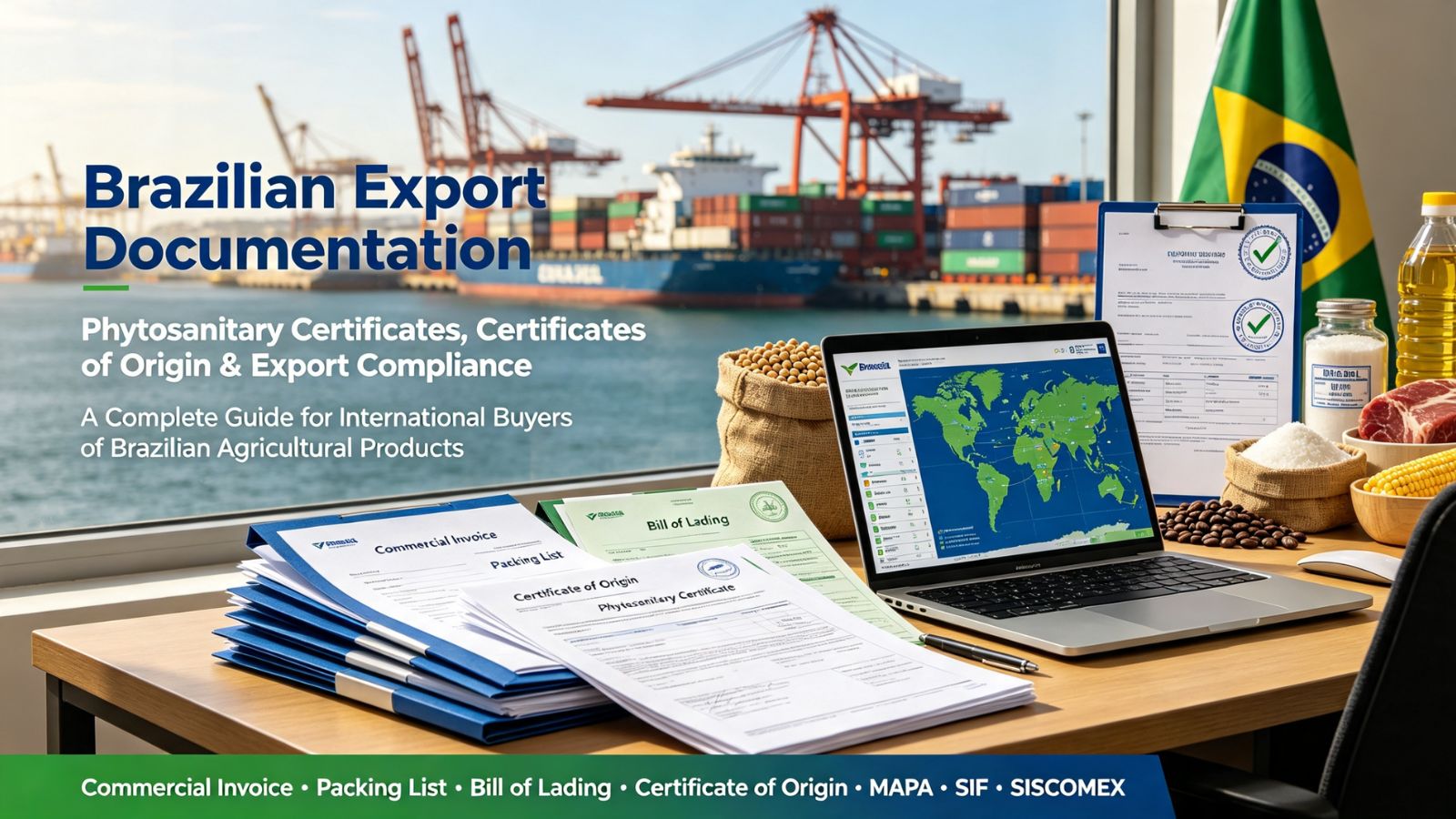
Brazilian Export Documentation: Phytosanitary, Certificates of Origin & Compliance

Related: How to Import from Brazil · Verify a Brazilian Exporter.
The 5 Mandatory Documents for Every Brazilian Export
1. Commercial Invoice
The commercial invoice is the value and description backbone of the shipment. It should state seller and buyer legal names, addresses, Incoterm + named place (e.g. FOB Santos, CIF Lagos), detailed product description matching the packing list and B/L, quantity, unit price, total value, currency, payment terms, and origin (Brazil).
Put the same product narrative on invoice, packing list and B/L. Banks and destination customs flag “soybean meal” on one doc and “soybeans” on another even when the parties “know what they meant.” For multi-product containers, itemize lines. Do not hide mixed cargo behind a single vague description.
2. Packing List
Lists packages, net/gross weights, volumes, marks and numbers, and container numbers when containerized. For bagged sugar or coffee it should reconcile bag count × bag weight to invoice quantity. For meat cartons it should reconcile carton count and net weights to the health certificate where applicable.
3. Bill of Lading (B/L) or Sea Waybill
Issued by the ocean carrier. It evidences receipt of goods for carriage and, in original B/L form, can control release. Telex release / express release practices vary by trade lane and bank. Confirm early whether your LC requires full set original B/Ls.
Consignee accuracy: Wrong consignee or notify party on the B/L is one of the top amendment causes on Brazilian container trades. Send the exact consignee block your broker wants before draft B/L approval.
4. Certificate of Origin
States that goods originate in Brazil. Used for preference claims under trade agreements (when rules of origin are met) and sometimes for non-preference destination formalities. Issued via authorized Brazilian channels (often chamber/federation pathways) based on exporter application and supporting evidence.
Preference savings only work if the certificate matches the preferential rule set your destination claims. Policy literature on preferential trade repeatedly shows that incorrect origin certificates are a leading cause of preference denial. The cargo still clears, but at MFN duty. Validate preference eligibility with your broker before you pay a premium for “preferential CO.”
5. SISCOMEX Export Registration (Brazilian export customs system)
SISCOMEX is Brazil’s integrated foreign trade system. Legitimate exporters (or their brokers) register export operations so goods can leave under Brazilian customs control. Buyers do not “log into SISCOMEX” themselves, but you should only deal with counterparties who can actually complete export registration and produce a coherent export document set.
“Who is the Brazilian exporter of record on the commercial invoice and export declaration?” If the WhatsApp seller cannot answer cleanly, stop. Layered “broker of a broker” structures are where document ownership breaks.
Product-Specific Certifications: What You Need by Category
Original matrix for procurement teams (confirm destination-specific extras with your authority):
| Product category | Core 5 docs | Typical Brazil-side add-ons | Common destination add-ons |
|---|---|---|---|
| Soybeans, corn, wheat, rice, pulses, seeds | Yes | MAPA phytosanitary certificate; quality/weight certificates if contracted; non-GMO/IP docs if sold as such | Import permit; residual testing; GMO declarations |
| Coffee & cocoa | Yes | Phytosanitary as applicable; quality grade docs; sometimes ICO-related trade paperwork historically for coffee lanes | Food safety registration; pesticide MRLs |
| Sugar (ICUMSA / VHP / liquid / invert) | Yes | Quality certificate (polarization, ICUMSA color, moisture); food-grade statements | Food import registration; sugar quota paperwork where relevant |
| Edible oils (soy, sunflower, palm, corn, etc.) | Yes | Quality specs (FFA, moisture, color); flexitank certificates; food-grade compliance | Food authority clearance; sometimes Halal for certain markets |
| Frozen meat & poultry | Yes | SIF-linked health/veterinary export certificates; Halal if required; cold-chain packing lists | Veterinary import permit; residue monitoring; Halal recognition lists |
| Dried fruits & nuts | Yes | Phytosanitary; aflatoxin/test certificates as contracted; organic if claimed | Aflatoxin limits; labeling rules |
| Spices (pepper, turmeric) | Yes | Phytosanitary; steam sterilization certificates if contracted; active principle specs (piperine/curcumin) | Microbial limits; contaminant tests |
Agricultural products (grains, oilseeds, coffee, cocoa)
MAPA (Ministério da Agricultura e Pecuária) oversees plant and animal health policy. Phytosanitary certificates support the importing country’s plant-health rules (pests, treatments, additional declarations). Your destination may require specific additional declarations. Share those texts with the exporter early so the certificate is not issued “generic” and rejected later.
Meat and poultry
SIF (Serviço de Inspeção Federal) is the federal inspection framework for animal products. Export programs depend on establishments operating under inspection and on bilateral market access. Buyers should request the establishment’s SIF identification and confirm the plant is eligible for their destination market. Market eligibility is not automatic for every Brazilian plant to every country.
Comparative food-safety system reviews emphasize that export eligibility is a combination of establishment approval and importing country listing, not a single stamp. Always verify destination listing status for the specific plant and species.
Processed foods (oils, sugar, flours)
Expect tight quality certificates aligned to contract specs (ICUMSA color, polarization, FFA, moisture, peroxide). Where food-contact packaging or private label is involved, artwork and labeling compliance is usually a destination-side responsibility unless contractually assigned.
Organic products
Organic claims require accredited certification and traceability. “Organic style” marketing without certificates is a compliance risk for both parties. Ask for certificate scope, crop year, and whether the specific lot is covered.
How to Verify That Your Supplier's Documents Are Legitimate
- Match names: invoice seller = B/L shipper (or explained principal/agent structure)
- Match quantities: invoice ↔ packing list ↔ B/L ↔ certificates
- Match ports and dates: load port, onboard date, certificate issue dates
- Verify CNPJ of the Brazilian company on Receita Federal tools (see verification guide)
- For meat, confirm SIF establishment and market eligibility
- For plant products, confirm phytosanitary additional declarations match import permit
- Under LC, run a dry documentary check against UCP rules before presentation
Ask for the packing list to show production/lot or batch codes that also appear on quality certificates. This is standard in serious food supply chains.
Common Documentation Mistakes That Delay Shipments
- HS code mismatch between invoice and destination entry declaration
- Incoterm place missing or contradictory (FOB without port; CIF without destination port)
- Spelling differences in company names across documents
- Certificate issued after B/L date when LC forbids it
- Phytosanitary missing required additional declaration
- Reefer set-point not stated anywhere in the document pack
- Mixed products in one container without line-item packing list
- Original B/L still in transit while cargo arrives (release planning failure)
How SAI AGRO BRAZIL Handles Export Documentation
SAI AGRO BRAZIL LTDA prepares commercial paperwork as part of a structured export workflow covering documentation, compliance alignment, packaging and shipment coordination for grains and oilseeds, edible oils, sugar and meat programs serving international buyers.
When you inquire, state destination country and mandatory certificates up front so the proforma and document checklist are built correctly the first time.
Need a document-ready quote?
Tell us product, destination and required certificates.
Frequently Asked Questions
What documents are required to export food from Brazil?
Core commercial set plus product certificates (phytosanitary, SIF health, Halal, organic) as applicable.
What is a phytosanitary certificate from Brazil?
A plant-health certificate under the MAPA framework confirming the consignment meets importing country plant-health requirements.
What is SIF?
Brazil's federal inspection service for animal products; export meat programs rely on SIF-inspected establishments.
Who registers the export in SISCOMEX?
The Brazilian exporter of record or their customs broker, not the foreign buyer.
Can documents be electronic?
Increasingly yes for some instruments, but banks and destinations still often require specific originals. Confirm per lane and LC.
Educational content only. Not legal advice. Confirm current MAPA, SIF, SISCOMEX and destination rules with licensed professionals. Requirements change by product and bilateral market access.